Uncategorized
sermorelin vs ipamorelin
Sep
Few comparison searches come up more often in peptide research supply than sermorelin vs ipamorelin, and it is easy to see why: both are laboratory peptides that support growth-hormone studies, both are ordered by the same kinds of research teams, and both are commonly stocked side by side in the same catalogs. Yet they are not interchangeable research reagents. They belong to different peptide families, they signal through different receptor pathways, they differ substantially in molecular size, and they are documented in different bodies of published literature. For a laboratory that needs defensible, reproducible results, the choice between the two matters before the first vial is even opened. This guide walks through both compounds in plain, practical language: what each peptide is, how their studied mechanisms differ, what the research literature actually covers, how purity and certificates change the picture, and how to reconstitute and store both compounds correctly. Everything here is written for research buyers only, and every peptide sold by PeptideLabNova is supplied for laboratory research use, not for human consumption.
Sermorelin vs Ipamorelin: What Each Compound Is
Sermorelin is a synthetic 29-amino-acid peptide that corresponds to the bioactive fragment of growth-hormone-releasing hormone, the natural hypothalamic peptide that stimulates the pituitary to release growth hormone. Because it shares the active sequence of the endogenous molecule, researchers use sermorelin as a model compound for studying the regulation of the growth-hormone axis without depending on the full-length native hormone, which is difficult to work with in vitro. The peptide is supplied lyophilized for stability, and reference preparations have been available from research supply vendors for decades, which is one reason the compound appears so frequently in endocrinology and metabolic research.
Ipamorelin, by contrast, is a small synthetic pentapeptide that belongs to a different family of growth-hormone-releasing peptides. It is substantially smaller than sermorelin — its molecular weight is only a few hundred daltons, compared with the low thousands for the 29-amino-acid peptide — and that size difference is not cosmetic. The same milligram mass of ipamorelin contains far more peptide molecules than an equal mass of sermorelin, so solubility limits, reconstitution math, and molar dosing all behave differently at the bench. In the published literature, ipamorelin is studied as an analog within its own releasing-peptide family, with its own receptor selectivity profile, and it is frequently discussed in the context of comparative endocrine research rather than as a substitute for the native-hormone fragment.
That distinction is the core of the sermorelin vs ipamorelin question for buyers: the two peptides look similar on a catalog page, because both are marketed as research peptides that support growth-hormone studies, but a methods section that names one cannot simply be copied with the name of the other. The molecular forms, the signaling pathways, and the published data sets are all different, and a careful research buyer treats them as two separate reagents with two separate documentation needs.
There is also a practical supply-side dimension that new buyers sometimes miss. Research peptides are manufactured in batches, and each batch is a separate analytical event: its own synthesis, its own purity run, its own certificate. That is why the same product from the same supplier can vary slightly from one batch to the next, and why good buyers standardize on a batch number when they start a study. This applies equally to both compounds discussed here, and it is one more reason to look at the certificate before the vial, not after.
Another point worth stating plainly concerns naming. When a quote is prepared, laboratories should verify that the ordered name, the catalog identifier, and the certificate name all refer to the same peptide in the same salt form. Typos and shortcut names are common in lab orders, and a mismatched label is the kind of error that only surfaces weeks later during data review. The small discipline of matching three names at order time removes an entire class of downstream confusion.
Why Laboratories Compare Sermorelin vs Ipamorelin
Research teams looking at the comparison between the two are usually building one of three kinds of protocols, and knowing which category your lab falls into makes the rest of this guide much easier to apply.
- Comparative endocrine studies. The aim is to observe how two growth-hormone-releasing peptides differ in potency, time course, or receptor behavior under identical conditions. In this design the comparison is the experiment, and both peptides must come with equivalent documentation so the arms of the study are matched.
- Receptor-profile work. The team is studying the signaling family each peptide belongs to, which means the source of each compound and its identity confirmation matter more than any functional claim in the vendor description.
- Model-system optimization. The laboratory is standardizing an assay and wants to pick the peptide that is easiest to source reproducibly, with consistent purity across repeat orders. Here the deciding factors are batch documentation, availability, and reconstitution behavior.
In all three cases the practical takeaway is the same: the choice must be decided on the basis of the protocol and the documentation, not on the similarity of the product names. Two vials from the same shelf can support very different experiments, and the research-use framing applies equally to both. Buyers who are comparing sermorelin vs ipamorelin for an upcoming project should therefore put the research question on paper first, then evaluate each compound against it.
How the Mechanisms Differ in Practice
Both peptides act on the growth-hormone axis, but they arrive at that axis through different signaling families, and that is precisely what comparative publications emphasize. Sermorelin, as the fragment of the natural releasing hormone, is studied through the receptor pathway associated with the endogenous molecule, which makes it a convenient model for questions about how hypothalamic signals are translated into pituitary output. Ipamorelin, as a member of the smaller releasing-peptide family, is studied through a different receptor profile, which is why some publications describe its selectivity and potency in terms that do not apply to sermorelin.
For a research bench these differences translate into observable experimental variables: effective concentration ranges, response timing, and the cell or tissue models in which each peptide has been characterized. It is not unusual for one laboratory to report that a given model responds cleanly to one compound and for a second laboratory to find the opposite, because the research question, the model, and the preparation method — not the peptide alone — determine the outcome. Comparative results are also sensitive to how fresh the solutions are, which is one reason rigorous teams pair concentration-response runs with careful reconstitution notes.
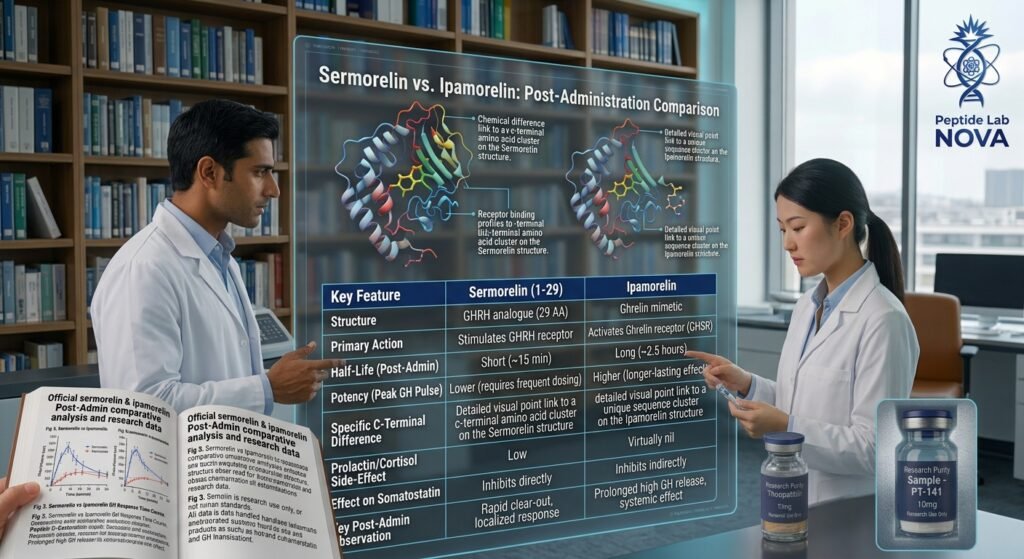
| Question | Sermorelin | Ipamorelin |
|---|---|---|
| Molecular form | 29-amino-acid peptide, fragment of the endogenous releasing hormone | Small synthetic pentapeptide from the releasing-peptide family |
| Signaling family | Mimics the native hypothalamic releasing hormone | Analog within a separate releasing-peptide family |
| Typical study models | Endocrine regulation, pituitary and hypothalamic models | Comparative releasing-peptide and receptor studies |
| Reconstitution math | Standard mg-to-mL calculation for a large peptide | Different molar math due to the much smaller size |
| Documentation needs | Batch COA naming the peptide and the analytical method | Same-level COA requirements as any research peptide |
Sermorelin vs Ipamorelin: side-by-side at a glance
If a reviewer asks why a laboratory chose one compound over the other, the defensible answer rests on the molecular form, the studied pathway, and the documentation — the rows that matter most in the table above. A quick side-by-side comparison is useful for planning, and the table can be reprinted in a lab notebook as a dated reference for the decision. Keeping that record is a small habit with a large payoff when the study is written up. In practice, the sermorelin vs ipamorelin comparison distills down to those bench variables, and everything else — catalog descriptions, marketing language, forum opinions — is background noise until the protocol has been defined.
What the Published Literature Actually Covers
The best starting point for any research buyer is the primary literature itself. Both compounds have their own PubMed indexes, and reading them side by side shows quickly that the two research streams cover different ground. The sermorelin index is deeper and older, because the peptide is the direct synthetic fragment of the native hormone and has been used in endocrine research for decades. The ipamorelin index is smaller but steadily growing, and it clusters around the compound as a member of its own peptide family rather than as a stand-in for the native molecule.
- Sermorelin literature: PubMed index for sermorelin
- Ipamorelin literature: PubMed index for ipamorelin
- Axis-level background: PubMed index for growth-hormone-releasing peptides
When scanning these indexes, it helps to look at the study design details rather than just the titles: which model was used, whether the compound source and purity are stated, and how the peptide was prepared. Publications that describe their reagents carefully are the most useful comparators, because they give a reader enough detail to reproduce the conditions. The publication volume on one side of the comparison is not, by itself, evidence of suitability for a particular protocol — it is evidence of history, and history and suitability are different questions.
Researchers often combine a quick scan of these three indexes with the site’s own lab reports page, which explains how third-party analytical testing supports the compounds supplied to laboratories. The point of reading the literature before ordering is that the choice between sermorelin vs ipamorelin becomes a documented one: the protocol names a family, the family points to an index, and the index supports the selection of the reagent.
| Index | Typical content | Best use for a buyer |
|---|---|---|
| Sermorelin (deep, mature) | Long history of endocrine and axis-regulation studies; many describe reagent sourcing | Background reading for protocols that model the native releasing hormone |
| Ipamorelin (compact, growing) | Family-specific and comparative releasing-peptide studies | Targeted reading for analog and receptor-profile questions |
| Both together | Quick check of study designs, models, and preparation details | Documented rationale for choosing one compound over the other |
The table is intentionally simple, because the goal is not to rank the literature but to match it to the experiment. A buyer who can point to the row that supports a protocol has already built the first paragraph of a defensible methods section.
Peptide Form, Purity and Documentation
For research peptides, the certificate of analysis is where the catalog description meets the physical reality of the vial. When a laboratory evaluates sermorelin vs ipamorelin as candidates for an order, the purity and identity documentation should be assessed on the same scale for both compounds: high-performance liquid chromatography (HPLC) purity on the exact batch, mass-spectrometry identity confirmation, and a batch number that matches the vial label.
Our beginner-friendly guide to reading a certificate of analysis walks through each field, and the same evaluation applies whether the label says sermorelin or ipamorelin. In practice, buyers should look for at least three things before an order ships.
- Batch-level purity. The certificate should report HPLC purity for the exact batch in the vial, not a range from a different production run.
- Identity confirmation. Mass spectrometry or an equivalent analytical method should confirm that the vial contains the peptide named on the label.
- Batch traceability. The batch number on the certificate should match the batch printed on the vial so the documentation chain is complete.
One detail that confuses first-time buyers is the difference between analytical purity and peptide content. HPLC purity describes what fraction of the detected material is the target peptide relative to other peaks on the chromatogram, but many peptide preparations are supplied as salts, which means a small percentage of the vial mass is the counterion rather than the peptide itself. A certificate that states peptide content, salt form, or net peptide percentage gives a laboratory the information it needs for accurate molar dosing. When a protocol calls for a precise in-vitro concentration, this distinction is usually the difference between a defensible calculation and an approximation.
None of this changes the underlying chemistry of the choice between the two compounds, but it does change the reliability of the study. A well-documented small batch is a stronger research reagent than a poorly documented one, regardless of which family the peptide belongs to. Laboratories that maintain a simple certificate folder — one entry per batch, cross-referenced to the vial label and the experiment — find that audit time shrinks dramatically when the data are reviewed.
Reconstitution and Storage for Both Compounds
Lyophilized peptides are designed to be stored dry and reconstituted fresh, and both compounds follow the same general laboratory routine. The site’s reconstitution and storage guide covers the full procedure; the short version for both peptides is: store the lyophilized vials cold, dry, and sealed until use; reconstitute with bacteriostatic water; avoid repeated freeze-thaw cycles; and keep the reconstituted solution refrigerated for the duration of the experiment window.
- Solvent choice. Bacteriostatic water is the standard starting point for both peptides, and any deviation should be justified by the assay.
- Vial handling. Let the vial reach room temperature before opening to prevent moisture condensation on the lyophilized cake.
- Aliquot planning. Divide the reconstituted solution into single-use aliquots so no experiment is contaminated by repeated sampling.
- Documentation. Note the batch number and reconstitution date on the aliquot tube so the chain of custody stays clear.
Because the two peptides differ greatly in molecular weight, the molar concentration of a reconstituted solution differs even when the mg/mL value is identical, which is a source of subtle error in comparative work. Calibrating the two arms on molar rather than mass concentration avoids this trap and is one of the most common corrections reviewers request. Teams that work with both peptides often keep a preprinted worksheet with the molecular weight, salt correction, and target molarity for each compound so the conversion is never done twice.
Stability in solution is another variable worth recording. As a general practice, reconstituted peptide solutions are handled as short-lived reagents: used within the window appropriate to the compound, kept cold, and discarded rather than salvaged once the window passes. Writing the preparation date, the batch number, and the storage conditions directly on the tube removes guesswork from later troubleshooting sessions, and it makes the methods section far easier to write.
Which One Should Your Laboratory Choose?
The honest answer is that it depends on the protocol, and a vendor that tells you otherwise is not serving your experiment. Choose sermorelin when the study design needs the fragment of the natural releasing hormone or a deeper, older literature base to support the model. Choose ipamorelin when the design calls for a smaller releasing-peptide analog with its own family-specific profile. A practical way to make the call is to write down the research question, check which of the two PubMed indexes supports it, and then confirm the documentation requirements with the supplier before ordering.
Once the design is settled, the sermorelin vs ipamorelin decision really is a documentation decision as much as a chemistry decision. For most comparative questions, the strongest design keeps both arms pure: one vial per compound, one batch per arm, one certificate per batch, so that the only variable being tested is the peptide itself. Mixing both into a single vial, or swapping sources mid-project, weakens attribution and makes the results harder to report. A small pilot run — a few wells, one batch of each compound, the exact reconstitution routine planned for the main study — can also surface handling problems weeks before the full experiment starts, which is cheaper than discovering them in the data.
Documentation-first thinking applies here too. Whichever compound the laboratory selects, the final decision note should record the research question, the literature consulted, the certificates reviewed, and the handling plan. That note becomes the backbone of the methods section, and it is the fastest way to answer a reviewer’s question about why this reagent was chosen over the alternative.
Buying Lab-Tested Sermorelin vs Ipamorelin
When the protocol is finalized, ordering is straightforward. PeptideLabNova supplies both sermorelin and ipamorelin as research peptides, and both sit in the anti-aging research category alongside other compounds used in endocrine and longevity research. Every order ships with the documentation discussed above, and the terms and compliance pages explain the research-use conditions that apply to every order placed on the site.
Buyers comparing the two for a first order should also plan for the arrival inspection before the package lands, so the lyophilized cake is not damaged in transit or exposed to conditions that shorten its usable life. The check takes less than a minute: confirm the label names the ordered peptide, confirm the batch number on the vial matches the certificate, confirm the seal is intact, and confirm the desiccant is dry. Each of those four checks belongs to the same documentation chain that begins with the certificate and ends with the methods section. If anything on the label does not match the certificate, the right move is to stop the unpacking, photograph the discrepancy, and contact the supplier before the vial is opened — resolving questions at receipt is far cheaper than resolving them after data collection.
Practical Bench Notes for Research Buyers
Finally, a short checklist that research teams often keep pinned to the lab board while planning a comparative project:
- Write the research question first, and let it pick the peptide family.
- Read the relevant PubMed indexes before ordering, not after.
- Request and inspect the certificate of analysis for the exact batch before it ships.
- Confirm the vial label, batch number, and seal when the package arrives.
- Reconstitute fresh, aliquot the solution, and refrigerate between uses.
- Treat the two peptides as separate reagents with separate documentation, even when they arrive in the same order.
The goal of this guide has been simple: to make the sermorelin vs ipamorelin choice a documented, bench-ready process instead of a gut call. Between the primary literature, the certificates, and the handling routine described here, a laboratory can compare the compounds rigorously and defend the selection in any methods section. For a first introduction to how research peptides are classified and supplied, the site’s overview of what research peptides are is a useful companion read before ordering.
Frequently Asked Questions
What is the difference between sermorelin and ipamorelin?
Both are growth-hormone-releasing peptides supplied as research reagents, but they act through different signaling families. Sermorelin is the shortened synthetic form of the native 44-amino-acid releasing hormone, while ipamorelin is a pentapeptide analog with a different receptor profile. For laboratory use, the practical differences are peptide form, published model base, and reconstitution math.
Can sermorelin and ipamorelin be studied together?
They can, but only with a clean design. Attribution is strongest when each arm uses a single compound with its own vehicle control; combining both in one vial makes it impossible to say which molecule produced an observed effect. Laboratories comparing the two usually keep separate vials, batches and certificates per arm.
How should sermorelin and ipamorelin vials be stored?
Store lyophilized vials cold, dry and sealed until use, away from light and humidity. Reconstitute with bacteriostatic water using the wall-directed technique, keep solutions refrigerated, and minimize freeze-thaw cycles. The site’s reconstitution guide covers the complete routine for both compounds.
What purity should sermorelin and ipamorelin have for research?
Set a minimum expectation of high-performance liquid chromatography (HPLC) purity at or above 98% on the exact batch, with identity confirmed by mass spectrometry and a batch number that matches the vial label. A certificate that names the batch and the method is the minimum documentation for defensible methods sections.
Sermorelin vs ipamorelin: which has more published research?
Sermorelin has the deeper and older literature, because it is the direct analog of the native releasing hormone; ipamorelin has a smaller but steadily growing publication base. Both PubMed indexes are worth reading side by side before finalizing a protocol, because the citation landscape changes quickly.
Research use only: The information above is a factual summary of product and literature context for laboratory research buyers. PeptideLabNova products are supplied exclusively for research purposes, are not intended for human consumption, and nothing in this article constitutes medical, veterinary, or clinical advice.
